
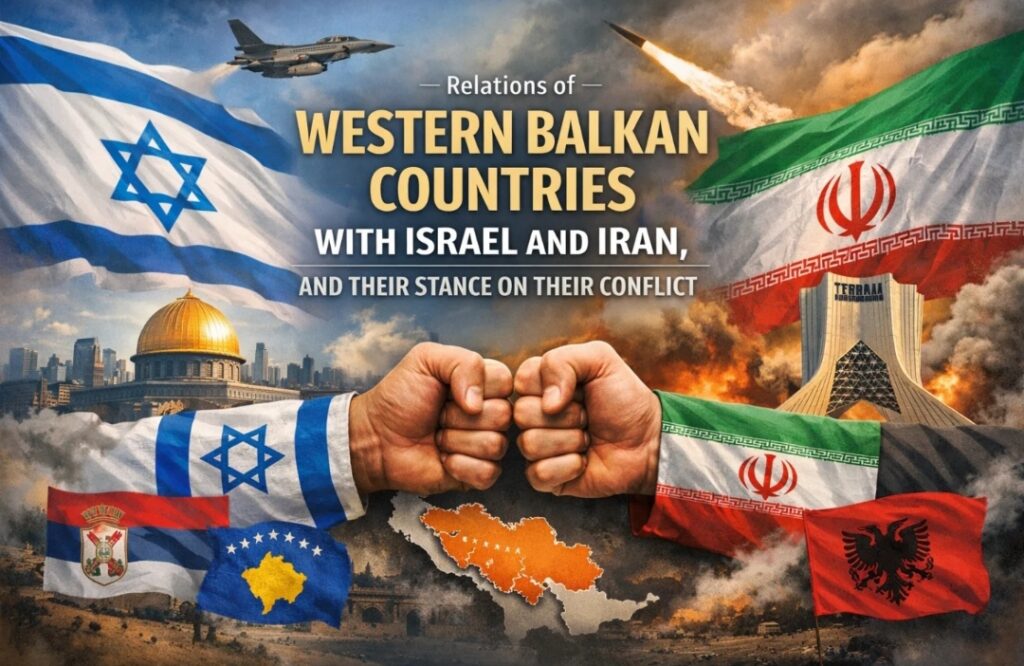
Although the Balkans are part of Europe, their historical, cultural, economic, and geopolitical ties are inseparably connected to the Middle East. These two strategically important regions are so deeply intertwined that some experts describe the Balkans as the “western wing of the Middle Eastern crisis.”
Given the bloody conflicts that have shaken both the Balkans and the Middle East over the past 35 years, as well as the fact that both regions represent geostrategic crossroads and areas of strong great-power presence, analyzing the relationships between the states of these regions becomes extremely important. It is particularly crucial to examine how events in one region influence political and economic developments in the other.
In this context, the current conflict in Iran, including the military activities of the United States and Israel, as well as Tehran’s responses toward Gulf monarchies, is drawing significant attention in the Balkans, with potential political and economic implications for the countries of the region.
Within this framework, by strengthening ties with Belgrade and Tirana, Israel is effectively building an informal geopolitical belt that limits Iranian influence in Bosnia and Herzegovina. This zone is not formal, but it functions as a buffer – protecting Israeli interests while simultaneously pushing the line of influence deeper into the European continent. Nevertheless, the Balkans remain a potential arena where the interests of Israel, Iran, and also Turkey could intersect, even if indirectly.
At the same time, all countries in the region, including Serbia, have formally aligned with the European decision to designate Iran’s Islamic Revolutionary Guard Corps as a terrorist organization. However, beneath this formal layer lies a much more complex reality. Every conflict in the Middle East has a direct impact on the Balkans, primarily through migration flows that naturally pass through this corridor.
In the background, Western security structures have for years warned that part of Iran’s network in the region operates through non-governmental organizations that serve as a cover for intelligence and logistical activities. Sarajevo is often cited as a key point, where diplomatic infrastructure exceeds typical frameworks, with frequent visits by operatives from European centers.
Serbia – balancing between interests
Within this complex arrangement, Serbia plays a double game. Officially, Belgrade claims neutrality in the conflict, interpreting it as an attempt at regime change in Iran, often compared to the 1999 NATO intervention and the fall of power in Serbia.
However, reality presents a more nuanced picture.
On one hand, Serbia has repeatedly refused to align with European Union sanctions against Iran, particularly those related to the nuclear program, human rights, or military cooperation with Russia. The key reason lies in Kosovo: Iran is one of the countries that does not recognize its independence, providing Belgrade with an important diplomatic advantage.
On the other hand, a gradual shift has been noticeable in recent years. The intensification of relations with Israel, military cooperation, arms exports, and the planned joint production of drones, as well as high-level political contacts, all indicate a move closer to the Israeli-American bloc. For years, it has been publicly known that Serbian President Aleksandar Vučić maintains a very friendly relationship with Israeli Prime Minister Benjamin Netanyahu. Another important link in these relations is Israeli political consultants such as Srulik Einhorn, a former advisor to Netanyahu and now an advisor to Vučić.
In September 2024, Israeli President Isaac Herzog visited Belgrade. A large economic delegation accompanied him, and he emphasized that ties between the two nations date back far into history, that the potential for economic cooperation is enormous, and that the ultimate goal is the signing of a Free Trade Agreement. The current Serbian foreign minister, Marko Đurić, can be described as the main pro-Israeli figure within the Serbian leadership. The recognition he received from the president of the powerful lobbying group AIPAC, Bernard Kaminetsky, is one indication of this, as is his Jewish heritage.
Additionally, following President Vučić’s visit to the United Arab Emirates during the conflict, where he clearly condemned attacks on Arab states, he sent a political message about Serbia’s strategic orientation. Nevertheless, balancing remains necessary: Iran because of Kosovo, and Israel as a channel toward American power structures.
Economic relations with Iran remain limited. Although there are examples of cooperation, such as increased imports of Iranian oil or business forums, overall trade exchange is modest. At the same time, political relations are maintained through occasional visits and diplomatic contacts. In July 2022, more than 80 Serbian and Iranian businesspeople, representatives of business associations, and government officials gathered in Belgrade at a forum that marked a potential beginning of stronger economic ties between the two countries. But external pressures pose a significant challenge to Iranian business activities. Although Serbia introduced visa-free travel for Iranians in October 2017, this decision was reversed just a year later under pressure from the European Union.
Bosnia and Herzegovina – a space of shadows
If there is a place where history and geopolitics directly intersect, it is Bosnia and Herzegovina.
During the war in the 1990s, Iran was one of the key allies, providing military, intelligence, and humanitarian assistance. Instructors, volunteers, and operatives arrived in the country, often disguised as humanitarian workers. Estimates of Iranian personnel vary, with some intelligence reports suggesting up to 4,000 individuals, including members of the Revolutionary Guard and Hezbollah. For Tehran, the Bosnian conflict served as an opportunity to demonstrate that it could influence events in Europe, despite being labeled a “rogue state” by the West. Iranian support also allowed the Islamic Republic to present itself to Muslims worldwide as a leader of pan-Islamic struggles. That period left a deep mark and opened the door to long-term influence.
After the war, under pressure from the United States, cooperation was abruptly terminated, especially after the “Pogorelica” affair, when a training camp under Iranian supervision was discovered. Sarajevo was then forced to make a clear choice between Tehran and Washington. Western governments feared the presence of Iranian spies and intelligence agents allegedly disguised as diplomats in Bosnia and Herzegovina and pressured Sarajevo to expel IRGC advisors. As a result, tensions emerged in Bosnian-Iranian relations, with Tehran viewing Bosnia as ungrateful for the support provided during the war.
Iranian activities in the region also face competition from other countries, particularly Saudi Arabia and Turkey, which compete for religious influence in the Balkans. Saudi Arabia, with its vast oil wealth, has been especially successful in promoting Wahhabi beliefs through numerous charitable foundations and has established a significant presence in the region.
Today, that influence is significantly weaker, but it has not disappeared. It is maintained through cultural institutions, education, and limited political contacts. In Bosnia and Herzegovina, the main instrument of Iranian religious diplomacy is the Ibn Sina Institute, established in Sarajevo in 1996. The center publishes Shiite theological works and Persian literature in local languages and maintains ties with Islamic faculties. It has also helped build a modest network of clerics and scholars connected to Iran in the region, particularly in the Sandžak area bordering Serbia and Montenegro.
Nevertheless, the political scene in Bosnia and Herzegovina remains deeply divided.
In Republika Srpska, there is pronounced pro-American and pro-Israeli rhetoric, along with announcements of severing ties with Iran. The leader of the Serbs in Republika Srpska Milorad Dodik stated that Israel and Republika Srpska face a “common existential threat posed by radical Islam,” expressed full support for Israeli Prime Minister Benjamin Netanyahu, and praised U.S. President Donald Trump for defending what he described as Judeo-Christian civilization. Republika Srpska has also spent millions of euros on lobbying contracts in the United States, according to media reports and filings under the U.S. Foreign Agents Registration Act, in an effort to reshape perceptions of its leadership and position within Bosnia and Herzegovina.
At the same time, silence dominates in the Federation, with sporadic contacts with Iranian officials. Last May, Bosnia’s Defense Minister Zukan Helez hosted the Iranian military attaché. Shortly afterward, the U.S. administration warned that any military cooperation with Tehran would result in the suspension of all forms of military cooperation between the U.S. and Bosnia and Herzegovina, prompting the minister to issue an official apology. A few years earlier, in 2022, Iran’s foreign minister met in Sarajevo with his Bosnian counterpart Bisera Turković and SDA leader Bakir Izetbegović.
From a security perspective, Bosnia and Herzegovina is considered the most vulnerable point in the region due to its historical legacy and existing networks, although they are much weaker today than in the past.
Albania – open conflict with Iran
Unlike others, Albania is in direct conflict with Iran.
The key reason is the presence of the Iranian opposition organization MEK, whose approximately 3,000 members live in the “Ashraf 3” camp. Their relocation was organized with the support of the United States and the United Nations but led to serious consequences.
Since then, relations between Tirana and Tehran have escalated, from accusations of terrorism to cyberattacks. A hacker group linked to Iran openly claimed responsibility for attacks on Albanian institutions, stating that they were retaliation for support given to the opposition. In response, Albania severed diplomatic relations with Iran and moved closer to Israel. Security cooperation has strengthened, including assistance in cyber defense.
Politically, Tirana has clearly aligned itself with the United States and Israel, supporting their operations and building a strategic partnership that includes the defense industry. One of the involved companies is the Israeli firm Elbit Systems Ltd., which signed a cooperation memorandum with Albanian authorities.
Today, Albania has three honorary consuls in Israel: one responsible for Tel Aviv, Jerusalem, and the central region; another in Haifa covering northern Israel; and a third in Eilat for southern Israel and the Negev. Around 54 Israeli companies currently operate in Albania, including the drip-irrigation company Netafim, and the country has become a popular destination for Israeli tourists, with seasonal direct flights connecting Tel Aviv and Tirana. Albania is also the third-largest source of heating oil for Israel.
Kosovo – the clearest positioning
Pristina’s support for the United States and Israel is open and unequivocal. The political leadership views U.S. policy as the key to security and even as a path toward change within Iran. President Vjosa Osmani stated that, thanks to the leadership of the United States and President Donald Trump, a time of freedom is coming for the people of Iran.
Kosovo was one of the Muslim-majority countries to establish relations with Israel in 2020. The normalization was separate from the Abraham Accords and part of the agreement between Serbia and Kosovo brokered by the United States. Israel became the 117th country to recognize Kosovo’s independence, declared in 2008. Jerusalem had previously refrained from doing so out of concern that it might set a precedent for recognizing a Palestinian state. In return, Kosovo opened its embassy in Jerusalem, becoming the first Muslim-majority country to do so. Relations were further strengthened through a series of bilateral agreements in 2022.
Kosovo has also approved sending troops to Gaza as part of an international security force under a U.S. initiative following last year’s ceasefire between Israel and Hamas. Several countries, including Indonesia, Morocco, Kazakhstan, and Albania, have pledged to send troops to participate in the International Stabilization Forces (ISF), maintaining peace and supporting a transitional administration in the Gaza Strip led by a “Peace Committee” under U.S. President Donald Trump.
The largest and most well-known U.S. base in the Balkans is located in Kosovo near Uroševac, but assessments suggest it is not a priority target for Iran, as it does not play a key operational role in current military activities.
Iran, for its part, does not recognize Kosovo and has no diplomatic relations with it.
Montenegro and North Macedonia – quiet allies of the West
Montenegro and North Macedonia pursue policies aligned with the West, but without harsh rhetoric.
Podgorica has invested significant funds in military cooperation with Israel and supported U.S. actions toward Iran, while emphasizing diplomacy. Since 2019, Montenegro has invested more than 50 million euros in contracts with Israeli defense manufacturers, and this cooperation continues to expand each year.
At the same time, there are indications that certain structures connected to Israeli and American circles play an important role in linking political elites across the region, with Podgorica being one of their key points.
Conclusion – the Balkans as a reflection of a larger conflict
In the end, the Balkans do not decide the conflict between Israel and Iran, but they reflect it.
As divisions in the Middle East deepen, the same patterns become visible in Southeast Europe: alliances, influences, historical ties, and new interests. Some states balance, some choose sides, and some become direct lines of confrontation.
In such an environment, the region remains stable, but fragile. Because every new shock in the Middle East does not end there. Its echo, sooner or later, reaches the Balkans.