
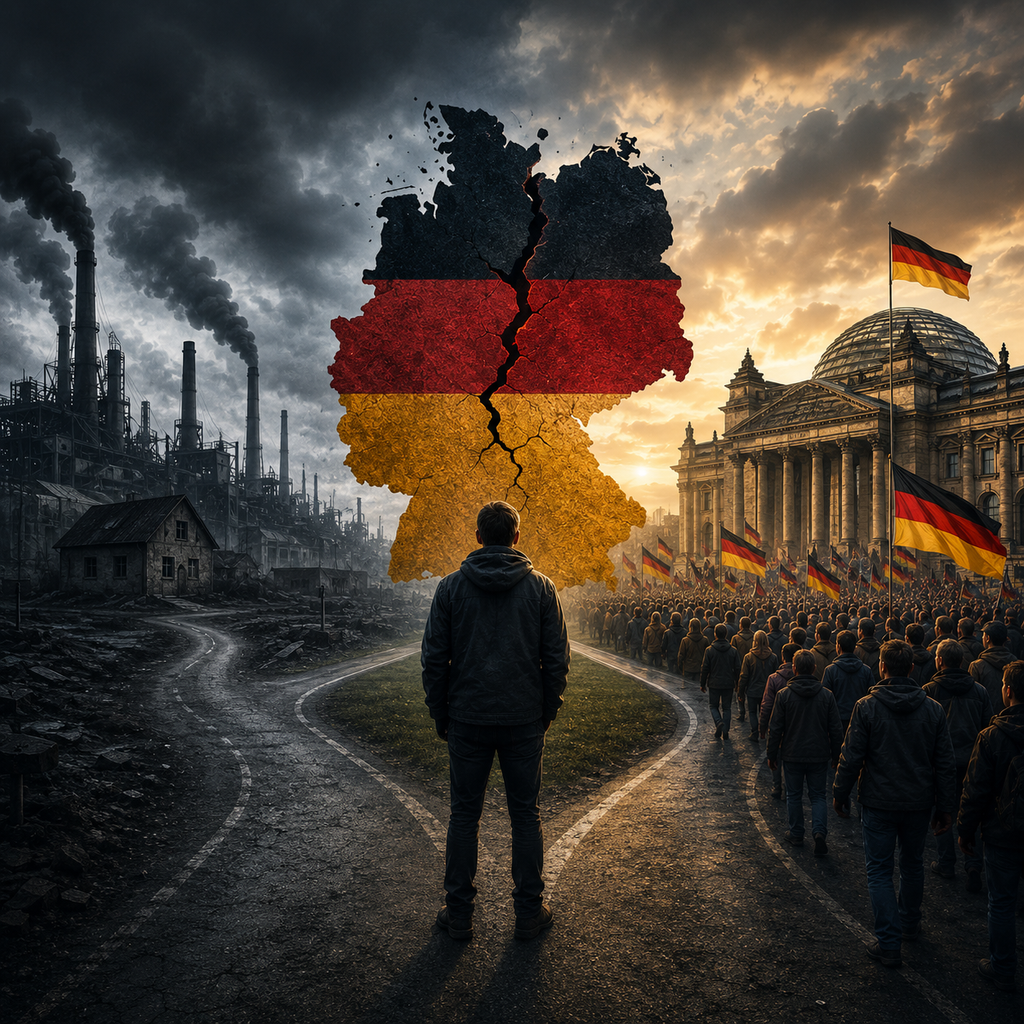
This weekend, very important elections are taking place in the German state of Saxony-Anhalt, which could completely change Germany’s political landscape if the AfD wins an absolute majority and forms a government in this eastern state. Although the entire German establishment is united against this party, the AfD continues to grow. Some people are asking why.
Why is the AfD growing?
Although many people look for answers in issues such as migration, geopolitics, the revival of some form of German nationalism, and populism, the main reason is much deeper and can be found in what matters most to citizens: the economy. We live in an era of global neoliberal capitalism which, in fact, is increasingly failing to work in the interests of the West. Citizens across Western countries are turning towards anti-establishment parties, whether in Germany, France, the UK, or the US, because they feel betrayed by their elites.
When we say that this economic model no longer works in the interests of the West, we primarily mean that it no longer works in the interests of the working and middle classes in the West, while benefiting those at the top of the economic ladder, namely capital owners, as well as those at the bottom, who receive the crumbs of the system in the form of social welfare. What we have ended up with is a fundamentally unfair model in which those who work and actually create additional value through their taxes finance both those at the top and those at the bottom.
All of this was first felt in the United States, the birthplace of the neoliberal global economic model, which became the world’s main hegemon after the fall of the Berlin Wall. Paradoxically, however, this was also when its internal decline began. American corporations started closing their factories on a much larger scale and relocating jobs to places where they could obtain cheaper labor, while ordinary Americans were left without jobs and watched their towns and cities in the American interior decline. Simply put, financial capital in America overtook manufacturing, and China’s unstoppable rise began. The consequences of this economic policy ultimately led to Donald Trump’s victories, both times.
We are increasingly seeing a similar process, with a delay, in Europe today, where deindustrialization is underway, that is, the relocation of factories outside Western European countries, first to Eastern Europe, but increasingly to other continents, above all Asia.
The old establishment parties do not talk about any of this, especially parties on the left, which by their very nature should represent the interests of the working and middle classes. Instead, they have effectively become the main promoters of this economic system, while focusing on secondary issues such as gender identities and other peripheral topics that nobody really cares about. This is why, alongside the rise of the far right, we are also seeing the rise of the far left across Western countries.
Why are even most members of the working and middle classes turning towards the far right rather than the far left?
This brings us to the issue of migrants. Although many left-wing experts will argue that voters who support parties such as the AfD or Marine Le Pen’s National Rally are racists or people who do not understand the benefits of multiculturalism, the problem is again deeper and is once again connected to economic premises.
The arrival of large numbers of migrants from underdeveloped countries to the West is not primarily driven by ideology or demographics, but rather by the interests of big capital and other employers, who reduce the cost of labor for domestic citizens by bringing in these workers without having to improve working conditions. Of course, there are genuinely certain sectors that cannot be staffed exclusively by domestic workers, but the narrative about labor shortages as a justification for migration is nevertheless exaggerated, because we are facing the paradoxical situation of rising unemployment rates in the West at the same time as new populations are arriving.
The far left, which opposes the neoliberal model while simultaneously advocating completely open borders, fails to understand that such a policy is in fact paid for primarily by domestic workers through higher property prices, worse working conditions, lower wages, weaker public services, and so on. That is why the issue of migration is more of an economic than an ideological question, and why members of the domestic working class increasingly choose the far right over parties of the left.
Although it would be excessive to speak of a theory of population replacement, one can nevertheless speak of the replacement of the working class. The best examples of this phenomenon are Balkan countries such as Croatia and Serbia, whose citizens leave for more developed Western countries in search of higher wages, while people from less developed countries in the Global South take their place, satisfied even with such wages.
Croatia, for example, is now among the EU leaders, even ahead of Germany, in the number of work permits issued to foreign workers, while around half a million of its citizens have left for other EU countries where wages are higher. The problem for average citizens in developed Western countries is that they have nowhere to go.
After all this, we return to the phenomenon of the AfD and its popularity, particularly in the states of the former East Germany.
One of the reasons why the AfD has such a high level of support in this part of Germany is the fact that many Germans here became the first losers of this economic system. Although the federal government has invested hundreds of billions of euros in the eastern states since reunification, you will often hear Germans from Saxony, Brandenburg, or Thuringia say that they were better off under the Russians than they are now in the Federal Republic of Germany.
The industries they once had were gradually lost, the quality of public services declined, and many young Germans moved to the western states in search of better wages and economic prospects. The AfD has recognized these problems and talks about them, albeit with a large dose of populism and without offering particularly concrete solutions.
That is precisely why one of the major questions facing Germany is whether everything should be done to prevent this party from coming to power anywhere, thereby potentially strengthening it further from the opposition benches, or whether it should be allowed to demonstrate what it can actually do, so that voters can ultimately become disillusioned with it.
Regardless of how these elections turn out, one thing is certain: the era of political stability, even in once highly stable democracies such as Germany, is over. And this economic model will remain in place until some major global turbulence eventually brings about a fundamental change.
Michel Zubenica
Political Consultant, CEO of Winning Strategy